Hello from Hamburg,
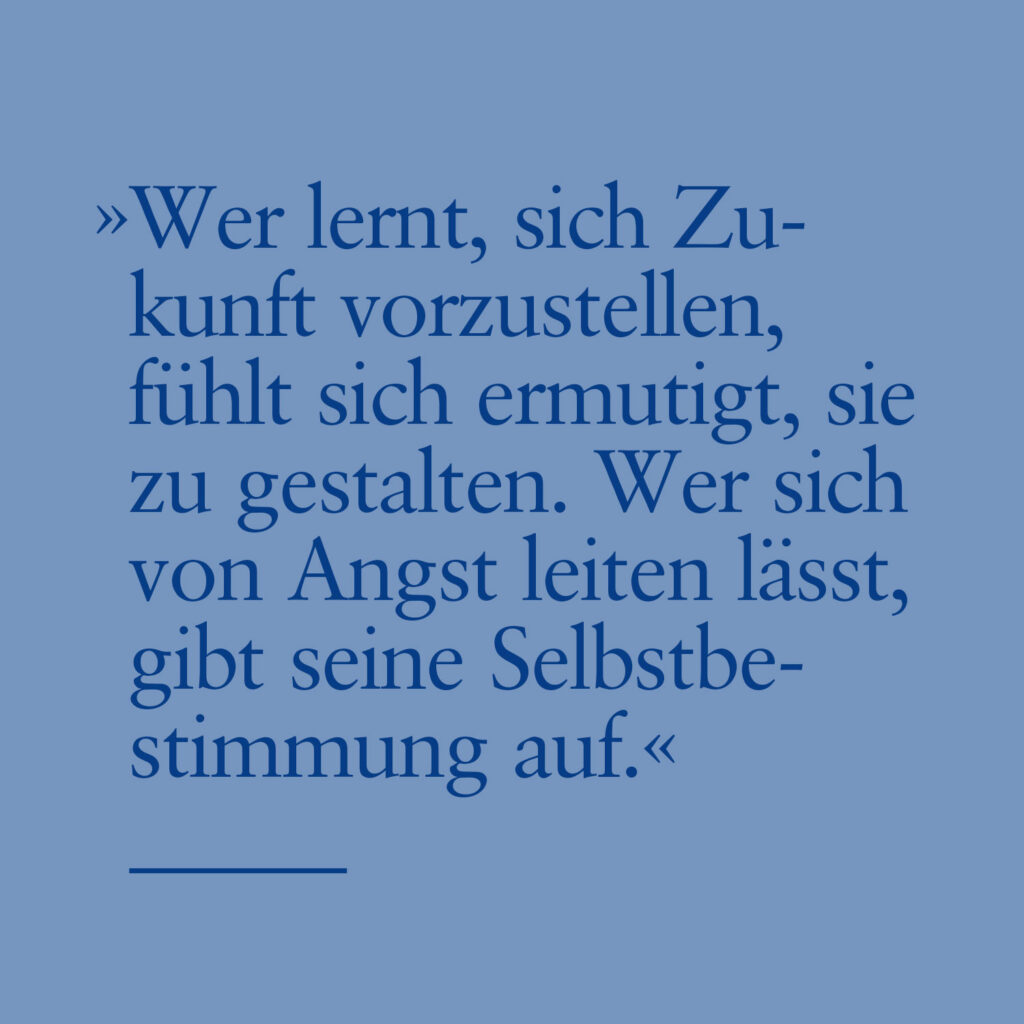
It is only human that, in times of great uncertainty, there is a surge in the desire to return to old certainties. Current fears of inflation, nuclear war, and nuclear and climate catastrophes are driving people into the arms of apologists for the “good old days” and of demagogues: Putin, who mourns his former empire and holds his country—and half the world—hostage for the sake of this dream—assuming he isn’t just a mafia boss disguised as a politician. The AfD, which counters these fears with a message of isolating Germans from the “foreign,” thereby maintaining a steady level of voter support. Those nostalgic for the GDR who pretend that life in East Germany, while more restrictive, was more beautiful. Politicians and the media, who paint a doomsday scenario of popular uprisings over high energy prices, further stoke fear and backward-looking attitudes and do a disservice to the population’s desire for direction. “People who are afraid pay a price: the surrender of their self-determination,” Rainer Hank wrote recently in the Frankfurter Allgemeine Sonntagszeitung.
A few weeks ago, I gave a presentation on how companies can plan when everything seems unpredictable. One of the panelists was a sociologist who spoke about the danger of “defuturization.” By this, he described companies’ attempts to encapsulate the future in a strategic vision and thereby provide direction. On the other hand, an overly detailed vision forces us into fixed commitments and robs us of options for action that we cannot yet foresee. “Scenario thinking,” so often touted by strategy consultancies, also attempts to colonize tomorrow with today’s ideas—because the development of future scenarios can only be based on what is conceivable today. This gives rise to a “present bias.” The speaker on the panel made a strong case for “futurization,” which views uncertainty as a resource rather than an enemy of planning. It is only by imagining unthinkable futures that we become aware that—and how—we can shape the future. Advocates of “future literacy”—an approach to developing visions of the future—use creative and playful methods to explore unknown future possibilities. Long-term psychological studies have shown that people who have learned to imagine the future are less afraid of it and are encouraged to shape it; every new business startup is a testament to this future-oriented drive.
There’s no doubt about it: Opinions differ on the relationship between the future and uncertainty, and societies are divided over this issue to the point of risking self-destruction. In his recently published and highly readable history of reactionary thought, Karl-Heinz Ott describes how this antagonism runs like a common thread through human history. He examines the debate between the two philosophers, Leo Strauss and Karl Löwith—who fled to the United States to escape the Nazis—who experienced the catastrophes of two world wars and a dictatorship firsthand. Strauss proclaimed that only closed societies could function—those underpinned by the greatest possible homogeneity, manageability, and a unified worldview. Anything cosmopolitan, universal, or global, he argued, contradicts the laws of nature; it fuels—as I would add—insecurity and prevents the future from being contained. Löwith countered that it is precisely the mutability of human beings and society that holds the only promise for the future. Ott quotes Löwith: “Today’s restorationists still want to ‘repeat’ and rehabilitate what has been ‘lost’… They (Strauss) ask: What is man, and what has become of him…? I say: ‘This is who we are now, and just imagine what man can still become!’”
Let’s not deny ourselves the freedom to envision and shape the future. Let’s not allow ourselves to be robbed of the courage to be self-determined. The many examples of successful new beginnings that have reached me since the last newsletter are a testament to what we humans can achieve in times of upheaval.