Hello from Hamburg,
Two excerpts from an employee survey on the leadership practices of their individual middle manager: “I had to come to terms with the fact that my manager isn’t able to make decisions because there’s a lot of internal micromanagement, such as deciding whether to allow working from home. Senior management is skeptical about working from home because they doubt that people are actually working. They criticize my manager when she allows employees to work from home.” “I’d like my manager to be better at meeting set internal deadlines. I realize that this is difficult because day-to-day operations don’t allow for it.”
In the October issue of BRAND EINS, Stephan Jansen cited studies showing that, in recent years, an alarmingly small number of employees have been aspiring to leadership roles. The reasons for this are varied. Middle managers are caught between the inadequate leadership skills of their superiors (a peculiar term!) and the expectations of their team members. This predicament is exacerbated by the current crisis. Middle managers are responsible for results. At the same time, given the current volatility, it is difficult to even set annual goals; the consequences of decisions are hardly foreseeable or controllable. Managers also experience their day-to-day work as a constant balancing act between their leadership duties and operational tasks. Ideally, managers should fulfill their responsibility for results by matching the right skills with the necessary tasks and focusing on leading their employees. The reality is quite different. A lack of ability or willingness to delegate, unexpected new operational issues, tight budgets, and too many routine processes that still haven’t been digitized are all reasons why managers are too deeply entangled in day-to-day operations.
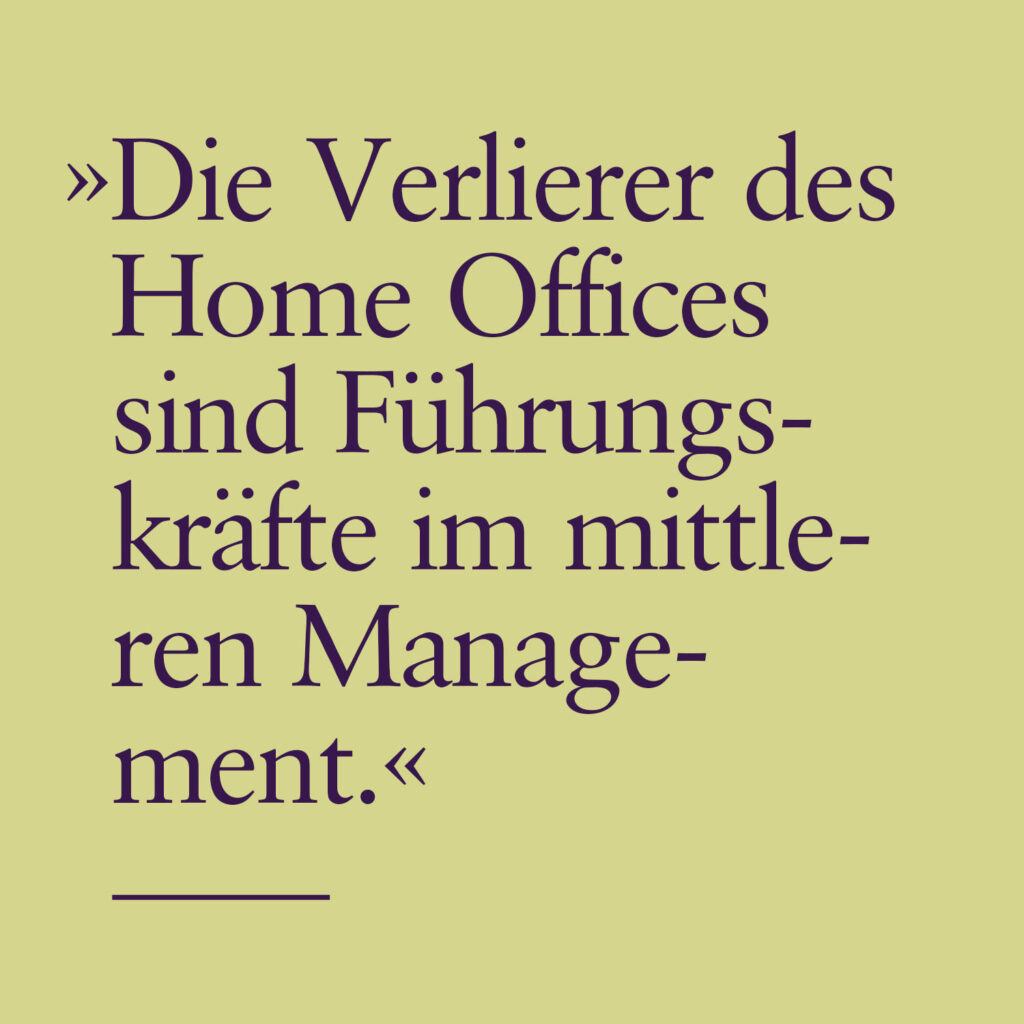
In addition, working from home—one of the consequences of the COVID-19 pandemic—is permanently changing our relationship with work. In a large-scale study by Microsoft involving 31,000 executives and employees in 31 countries, half of all respondents said they now focus more on their personal well-being than they did before the pandemic. As questions such as: “What am I willing to put myself through? What am I no longer willing to tolerate? Do I live to work? What’s more important to me: my job or my family?” the willingness to change jobs or become self-employed has increased significantly. Executives are confronted daily with these and other challenges related to remote work within their teams: high turnover, a loss of team cohesion, and dissatisfaction with the work culture. According to a study by Helmut Schmidt University, increased remote work among managers is associated with a greater experience of physical and mental strain and an increase in frustration. 74% of respondents say they do not have the opportunities or resources to bring about the necessary changes for their employees. The losers of remote work are middle managers.
The fact that an exodus among managers is beginning doesn’t have to be a bad thing. Leadership is about building relationships. And many managers weren’t promoted because they enjoy dealing with the nuances of human interaction, but because rewards for professional achievement often go hand in hand with increased leadership responsibility. Employees’ responses to the question of what managers can do better: “Pretty much everything could be done better. But there’s hardly any way things could ever improve—no matter how many training sessions are held for whatever purpose,” “For me, the question is why nothing is changing at all. Why doesn’t anyone care?” Many managers are burdened by their leadership responsibilities—and in doing so, they burden their employees. They’re in the wrong place.
What matters now is winning over—or at least not losing—those who want and are capable of taking on leadership roles. In other words, focus all our attention on them, rather than—as we often tend to do—spending most of our time on problem cases. Make them full-time leaders who have no operational responsibilities. Give them a sufficient budget to organize team retreats—two- to three-day off-site gatherings in beautiful locations—which fosters a sense of community that helps teams weather periods of remote work. Create communication channels within the company that enable ongoing dialogue within teams. Ask, “What do you need?” Offer continuous training on how to handle hybrid work situations. Outline career development paths within the company. And above all: Maintain constant dialogue, give and receive feedback on performance, and serve as a mentor.
Now more than ever, it’s time for “Emotional Officers” in middle management. It’s high time to put an end to all the nonsense about “soft” factors. After all, good leadership has long since become the most critical factor in a company’s success. Anyone who fails to recognize this will face a “vote with their feet.”