Hello from Hamburg,
Sometimes I go too far. That’s what happened in the last newsletter, where I wrote about current challenges and positive experiences in mutual learning between the older and younger generations (“Perpetrator or Victim”). If I offended anyone with the case studies—that was not my intention, and I’m sorry if I did.
I’ve seen from the number of interesting letters I’ve received that this topic resonates with people. For example, I heard from an engineer who spent a long career at a manufacturing technology company, eventually working at its plant in China. For the last five years of his career, he decided to stay in China and, as part of a team made up of young Chinese and German professionals, oversee the implementation of lean business processes and agile work methods. Young and old sometimes clashed fiercely, but in the end, they achieved a shared success, which was crowned by the team’s decision to name him the “Father of LEAN.” His advice: Don’t stay in the same position for too long; instead, switch to completely different tasks. Much like the American former head chef from the UK who now works as a manager at a tech company. One reader observed that leadership through control is found not only among an older generation but also among people in their 40s today. Another noted that learning is most effective when accompanied by constant reflection on one’s work. Thank you for your interest and for sharing your thoughts.
…
Speaking of learning: Just like every year, I once again attended a study week at Harvard Business School (HBS) with 15 professors and 180 entrepreneurs, business owners, and managers from around the world. As is customary at HBS, we learn through case studies—real-world business examples that we study thoroughly in preparation and discuss in the classroom, often with the key players, such as CEOs or shareholders, participating. This intensive week always serves as a barometer for what’s happening behind the scenes in the global business world. Currently, the focus is on the latest crises, alternative energy, artificial intelligence, and how a company’s profitability can be combined with a social contribution. Take, for example, a bank in Kenya that bases its business model, among other things, on serving the poorest segment of the population—those who lack access to a bank account and are thus excluded from social participation; in Kenya in the 1990s, this group accounted for 96 percent of the population. The bank provided microloans and encouraged customers to save in order to build up their assets. Today, the bank has not only grown to 16 million “members” (as the customers are aptly called) and $9 billion in revenue, but has also become the initiator of a new “Marshall Plan for East African nations.” James Mwangi, the bank’s longtime CEO and the inspiring driving force behind its success story, was initially denied admission to secondary school as a child—despite excellent grades—because his single mother could not afford the shoes required to attend school.
The topic was an e-commerce platform focused on selling and delivering affordable drugstore items to the overwhelmingly large segment of India’s low-income population living in particularly densely populated cities or in rural areas. Through a clever network of local structures, suppliers, existing kiosks, and vendors, the platform is making Amazon look outdated in this market with hundreds of millions of potential customers. Google is also experiencing disruption, even though its search engine remains its largest business. Alluding to the old photography company that missed its chance to enter the digital camera market, a professor predicted a “Kodak moment” for Google because ChatGPT is catapulting the logic of search engines into a new dimension and threatens to leave Google in the dust. The biotech company Moderna was well-prepared for mass production in the mRNA sector in a very short time during the 2020 pandemic, thanks to fully digitized processes. Now Moderna is setting out to make its production platform available to other biotech companies, thereby becoming the “Apple” of the biotech industry.
Former Treasury Secretary Larry Summers painted a bleak picture of the geopolitical situation and the global economy. There are many uncertainties: climate change, Taiwan, the ongoing war in Russia, and concerns about inflation and supply chains. The signs point to a major, structural upheaval of what we’ve experienced in the U.S. and Europe over the past few decades. Mixed in with this is the realization that each and every one of the students here can make a big difference in their own field. My classmate Husodo, who runs the largest pineapple plantation in Indonesia, is proof of that. His father arrived from China as a 16-year-old refugee with nothing to his name. Or Anthony from Lebanon, who fled to Cyprus after the devastating explosion at the Port of Beirut in August 2020 and founded the company bboxx, which uses a digital platform to provide sustainable energy and internet access to people in underserved regions across eleven African countries.
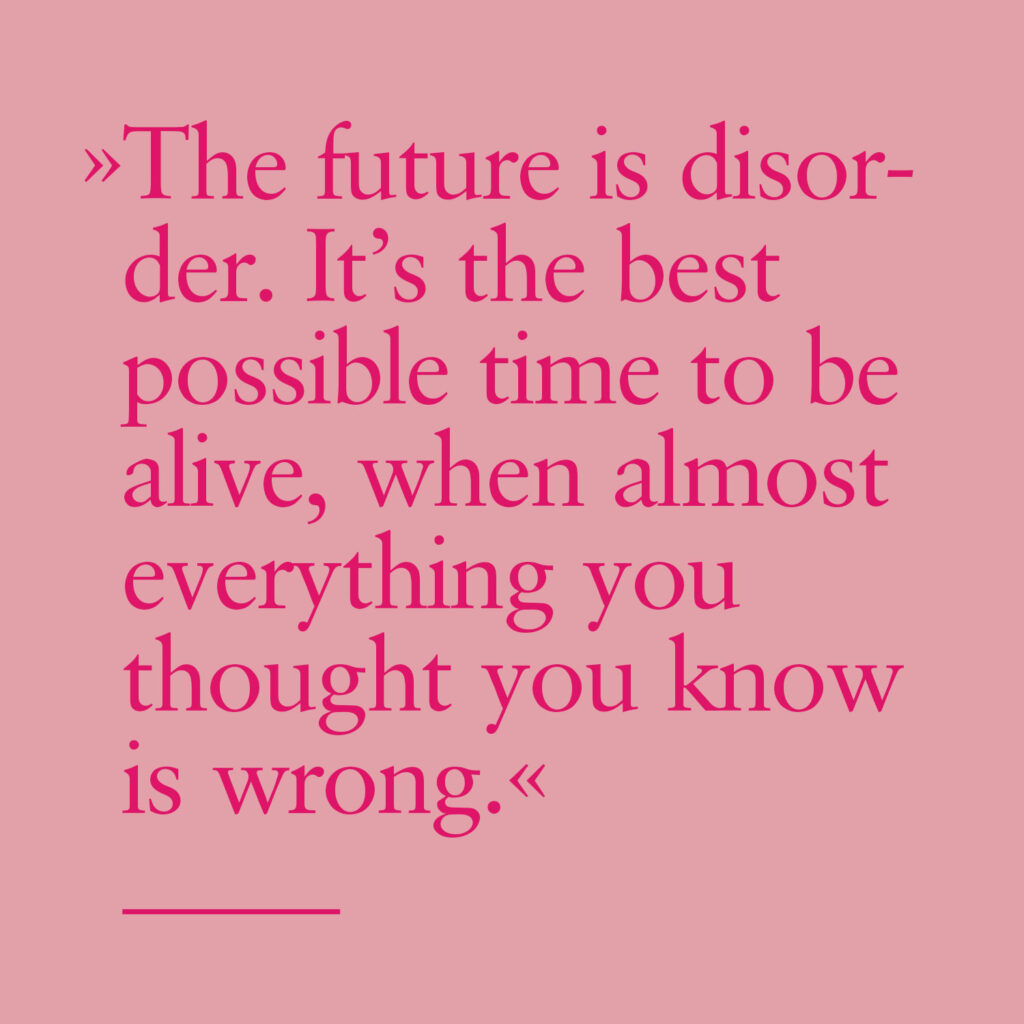
So, despite all the setbacks, this week of learning sends out a signal of new beginnings. And not just because of the progress made in learning and the inspiring encounters, but also because of the insight that the English author Tom Stoppard summed up in my quote of the week: “The future is disorder. It’s the best possible time to be alive, when almost everything you thought you knew is wrong.”