Hello from Hamburg,
I was recently leafing through the book *Uncertainty and Its Discontents* by Peter Katzenstein, a professor of international politics at Cornell University. Katzenstein reflects on how his field tends to think and act in terms of linear developments in international power politics, logical cause-and-effect chains, and the belief in a balance of power. No wonder, says Katzenstein, that many political scientists were caught off guard by events—such as a pandemic or a war of aggression by Russia in Ukraine—that had previously been considered impossible. Now experts are just as stunned as the vast majority of people in Western Europe and the U.S. Katzenstein remarks self-critically: We’d rather focus on gardening—where we know our way around, have a clear framework, and follow well-established methods—than venture into the jungle, where the unknown and the unthinkable lurk.
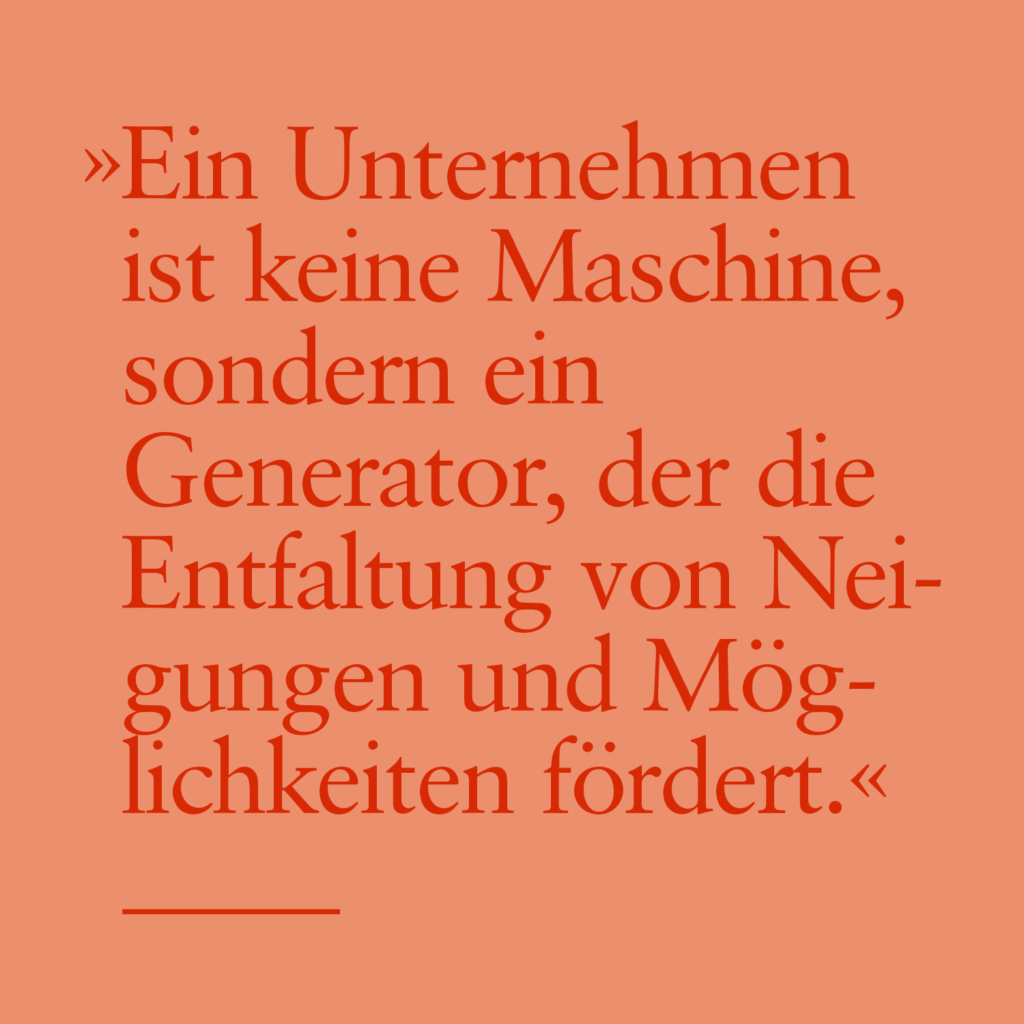
Katzenstein draws an intriguing analogy with physics, which, in his view, has come much further in dealing with uncertainty. With the advent of experimental physics and the study of subatomic structures since the late 19th century, scientists have long since moved beyond the mechanics of the Newtonian worldview of cause and effect. In its place came quantum mechanics, which deals with electrons, quarks, photons, and Higgs particles. These particles are not real in the sense of small pebbles, but rather tiny moving waves. Einstein explored the invisible world of energy, where chance reigns. Through experiments, quantum physicists discovered just how much this new world defied all rational attempts at explanation while simultaneously bringing about great progress. Quantum computing, with its immense computational power—which is replacing the binary structures of today’s programming world—is an example of such leaps in development. Katzenstein’s conclusion: “Seen in this light, the world is not a causal machine, but a creative generator of unfolding tendencies and possibilities… a restless swarm of events.”
Beyond physics and political science, I think about our day-to-day corporate life. It’s not constraints and necessities, but uncertainty, uncontrollability, and ambiguity that define our daily reality. It’s not just those concerned with the future of business models—all colleagues and employees are feeling a great deal of unease and uncertainty. I sense a strange mix of “business as usual”—when I listen to the works council’s ideas about the upcoming pay raise—and a sense of disorientation—when that same works council asks probing questions about the company’s direction. We try to get a handle on the situation by talking about “calculable risks” (isn’t that a contradiction in terms?), asking for “scenario planning” (which can only ever be based on what we know), and taking refuge in the day-to-day operations—the area where we know our way around.
All of this reflects a longing for the old logic of the Newtonian worldview—a yearning for certainty and causality. Meanwhile, a new era has dawned, one shaped by possibilities and probabilities, by waves and chance rather than straight lines and control. Now is the best time to create something new. To make radical decisions. To finish unfinished business. To put corporate strategies to the test. To formulate hypotheses—and, if necessary, to throw them out after some time. To train the organization to be curious, to equip it with antennae for the unthinkable. Katzenstein recommends humility, thoughtfulness, and the courage to admit to employees that we, too, don’t know.
At the same time, there is a need to generate profits. John Kotter speaks of two operating systems in which companies currently operate: one in which we create something new, and one in which we continue to optimize what already exists in order to generate the funds needed to finance the first. It’s no easy task to maintain two cultures under one roof.