Hello from Hamburg,
There's no sign of a summer break. Many companies are currently in a state of frantic anxiety. The pressure to cut costs while remaining innovative is intense.
The reason for this lies in the much-discussed crisis-driven phenomena that have taken hold in companies: price increases and inflation are causing consumer reluctance. Rising interest rates are undermining financing models in the construction industry. The long-standing business model of plant and machinery manufacturing—heavy reliance on exports to China and low-cost production there—is proving to be a thing of the past. The restructuring of the energy supply caused by the climate crisis and the war in Ukraine is driving up energy prices. There is a shortage of skilled workers. The German automotive industry is facing market changes that threaten its very existence: growing competition, a shrinking Chinese market, alternative powertrains, and changing consumer behavior. German small and medium-sized enterprises (SMEs) are too small and too expensive to stand up to the global giants, yet too large to be insignificant. This is one reason why Viessmann sold its heat pump division to the U.S. corporation Carrier Global: it could not have produced the required volume of heat pumps at a market-competitive price fast enough.
Quite a few small and medium-sized businesses failed to do their homework over the past “golden decade” and did not consistently pursue the urgently needed digital transformation or sufficiently automate their processes and workflows. They now face a pressing need to catch up, which will require significant investments in a very short time.
These are certainly not times for the faint of heart. How can we manage cost pressures and investment needs amid high levels of strategic uncertainty?
Surprisingly, quite a bit is being accomplished, as a look into the engine room reveals. The pressure is making things possible that long seemed impossible. Internal operational decisions that once went through many internal loops are now made in the blink of an eye. Fail early, learn fast, and drive innovation together with the customer, rather than spending a long time and a lot of money searching for the supposedly perfect product—agile work methods are now part of everyday life in many places. The pressure to achieve greater efficiency in its core business is prompting a biotech company, for example, to partially automate production processes during night shifts after many years of unsuccessful attempts. The need to refocus is forcing a plant engineering firm to finally divest itself of a business segment that has been operating at a loss for ten years and can no longer compete with lower-cost rivals. Office rent payments can be significantly reduced because the balance between working from home and in-office time is gradually stabilizing at a reasonable level.
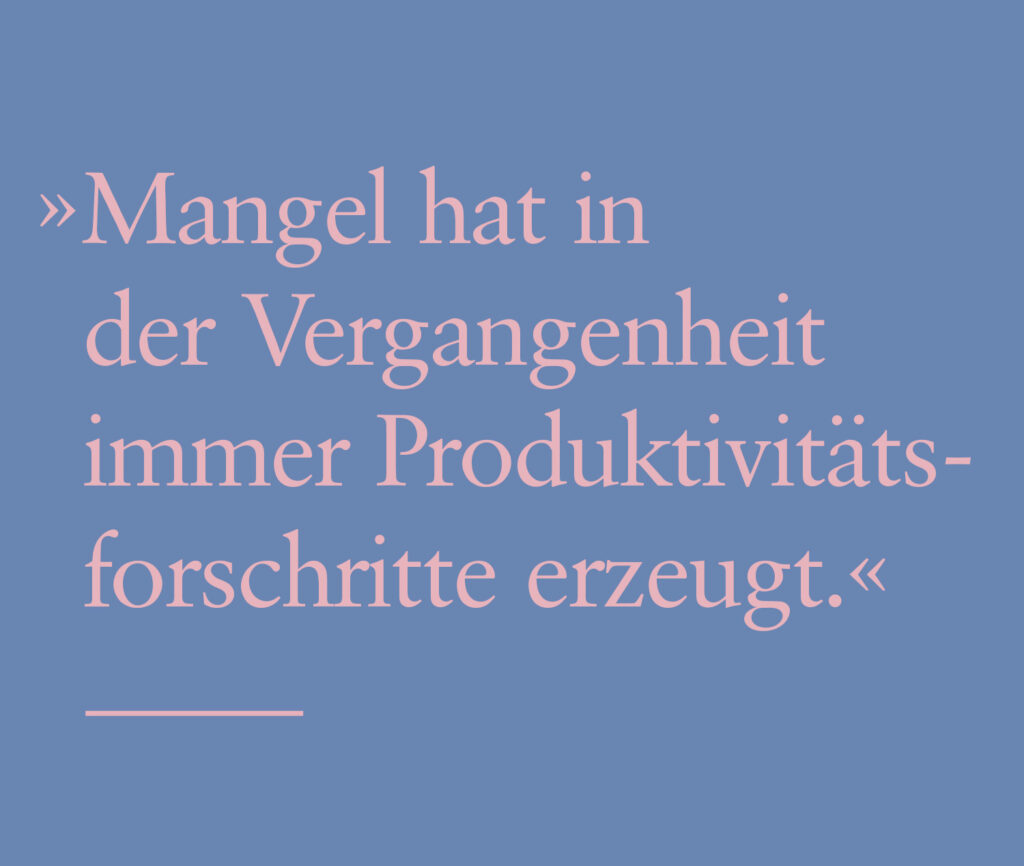
Constraints foster creativity. It has always been that way. British historian Harold James makes this clear in his book *Moments of Shock*, in which he examines seven crises between the mid-19th century and the COVID-19 crisis. According to his analysis, crises of scarcity have always led to gains in productivity that have benefited everyone. For example, a major famine in Central Europe in the mid-19th century triggered a surge in globalization that helped alleviate the supply crisis. The labor shortage helped long-existing technologies, such as the steam engine, achieve a breakthrough and spurred mechanized mass production in Europe’s coal-mining regions. It was only the restrictions imposed by the COVID-19 crisis that led us to embrace long-standing technical possibilities such as video conferencing and digital forms of collaboration—and today we can no longer do without them.
Tom and David Kelley, pioneers of the Design Thinking innovation method, identify the principle of constraint as one of the most important sources of creativity. They illustrate this thesis using the story behind the development of an app that allows children to create their own avatars. Due to the client’s lack of money and time, the prototype was developed without any coding and within a week using a webcam simulation. More budget, more time, and more staff—which we reflexively call for when we’re tasked with generating innovations—are guaranteed to slow things down, complicate the process, and ultimately lead to a lack of results. Necessity is the mother of invention.
There is reason to be confident that this crisis, with all its restrictions, will bring about long-overdue changes and result in far fewer people being left behind than feared.
What amazing things are you currently experiencing in your company that you never thought possible before?