Hello from Hamburg,
It’s hard to say exactly how many meters of bookshelves are filled each year with titles on the importance of appreciative leadership. Engaging with employees, listening, providing ongoing feedback, and treating one another with care—all of this has now become part of the basic principles of good leadership behavior in everyday life. The growing awareness of appreciation in the workplace is leading to the gradual replacement of a leadership culture based on command and obedience, one that has its roots in industrialization. This development is fueled by generational change and the current upheavals in our companies, which require new perspectives and a new generation of professionals and leaders who are open to them.
It’s fortunate, then, that thanks to the ubiquity of information and dialogue, younger generations are accustomed to communicating and acting in a less hierarchical manner. They are few in number, which gives them bargaining power and allows them to shape an organization’s culture. A well-educated young professional recently explained to me that she couldn’t imagine working for a company where supervisors used profanity; she would leave, even if she had no alternative. Corporate HR departments are trying to meet the needs of this demanding generation; the seemingly endless discussions about remote work policies are one example of this. This generation has weathered collective uncertainty caused by the pandemic, the climate crisis, and a war of aggression in Europe; younger employees are wondering how to strike a balance between work and life and what they want to achieve in life. Many older colleagues, who have prioritized work their entire lives, are at a loss regarding the behavior of the younger generation and no longer understand their world.
But does young people’s need for harmony align with the tough decisions many companies face? You don’t have to go as far as Elon Musk did when he took over Twitter—firing 50 percent of the staff with the comment that there was no other option when a company is losing four million dollars a day. Steve Jobs, who built Apple into a powerhouse, was also known to regularly hijack employee meetings and ruthlessly scrap six of the seven painstakingly developed goals for the coming years: Only one mattered, not seven. And Mario Kohle, co-founder of the solar panel rental company Enpal, makes it clear what happens to those in charge when ambitious goals aren’t met: There’s a second chance, but if that’s missed, he’ll bring in others.
This is the daily tension between the urgent need for change and the natural inertia of established organizations: thinking and acting within departmental boundaries, meetings that end without decisions, and listing reasons why something won’t work. And anyone who has lived through this contradiction will have a certain understanding for radical decisions à la Musk and Co. After all, how are we supposed to overcome the “ifs” and “buts” of an organization that has become complacent without an uncompromising stance? There’s no denying it: Even though Musk had to partially reverse his decision to lay off employees in the aforementioned Twitter case—without his own radicalism and that of a Steve Jobs, major entrepreneurial achievements would often never have happened. There would have been no breakthrough innovation like the iPhone and no revolution in propulsion like the one in the auto industry thanks to Tesla.
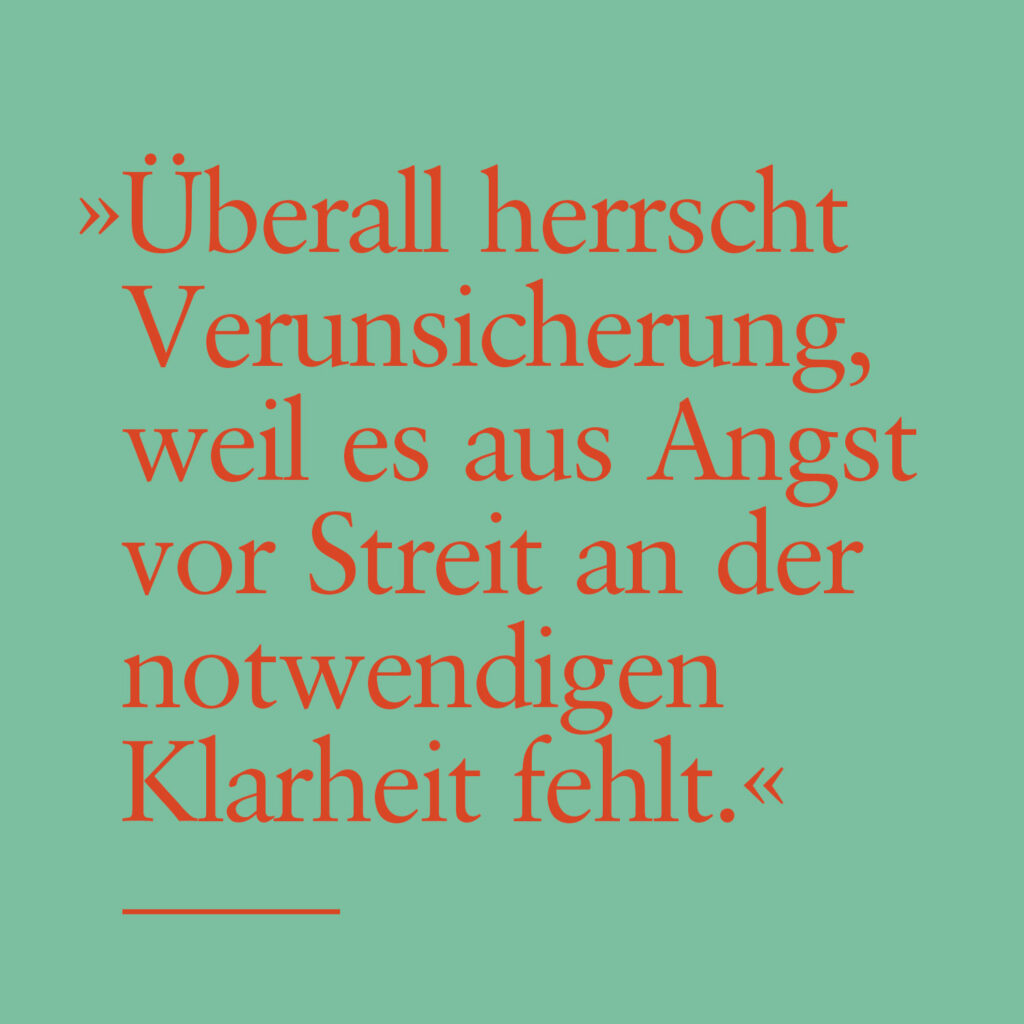
This is not a call for a strongman—the jerk as a leadership role model. Satya Nadella, CEO of Microsoft since 2014, has demonstrated that major transformations can be led differently, as detailed in his self-critical book *Hit Refresh*. But the confusion between appreciative leadership and the pursuit of harmony is evident everywhere, as is the general sense of uncertainty that arises when the necessary clarity is often lacking due to a fear of conflict. This leads to a paralysis that we simply cannot afford. To quote management expert Reinhard Sprenger: When leaders strive to constantly cater to the needs of their employees, they become victims of over-adaptation.
What do you think: Can we overcome internal resistance to change at the necessary pace only by pushing through radically? Or how do you lead without being a jerk?