Hello from Hamburg,
Uncertainty fills the room: “What’s going on at the company?” ask the members of the advisory board, while management explains why the strategy isn’t taking hold. There’s talk of one-time factors that are forcing all executives to engage in operational firefighting: the lingering effects of the COVID-19 pandemic, supply bottlenecks, quality issues, inflation, and price increases. Different figures are circulating about the state of liquidity—depending on how you calculate it. Why is turnover alarmingly high, especially among young managers? The new generation isn’t willing to commit, they say. Everyone in the industry is struggling with this.
None of these statements is wrong on its own. But taken together, they don’t make sense. Everything is true, yet nothing is right. An advisory board cannot assess the situation any more accurately than that because it is too far removed from day-to-day operations. What remains is an uneasy feeling that management is merely describing symptoms.
It’s normal for a set of facts to be interpreted in different ways. Every day, we piece together a picture from many bits of information. And in doing so, as administrative scientist Gunnar Folke Schuppert has pointed out, human beings tend to weave a plausible narrative out of the multitude of news items and events. This is usually an unconscious tactic to reduce complexity. It was true around the warming campfires of hunter-gatherers, in the caravanserais of the ancient Silk Road. And it’s true today on social media and in everyday corporate life as office gossip in the break room. In extreme cases, this gives rise to conspiracy theories—which are actually conspiracy narratives. These cloud our judgment and turn narratives into facts. In other words, fake news.
As a historian, I have learned that every generation rewrites history. In my doctoral dissertation, I studied a 17th-century publicist who railed against the expansionist policies of the French Sun King, Louis XIV. This figure enjoyed great popularity among historians at the end of the 19th century—at a time when anti-French sentiment was widespread. A hundred years later, while writing my dissertation, I read different truths into the texts. Having grown up with the narrative of Franco-German friendship as the most important pillar of a united Europe, I corrected the interpretations of my historical predecessors.
Back to the Advisory Board’s search for the root of the problem, as described at the beginning. A series of interviews with specialists and managers soon revealed that there was no shared understanding of the direction the company was heading. This was nothing less than a glaring leadership deficit, and it became clear what needed to be done: A strategy had to be developed collaboratively—one that had the potential to grow into a movement within the company and to redefine the collaboration between the advisory board and management. It was also clear that a change in corporate leadership was necessary.
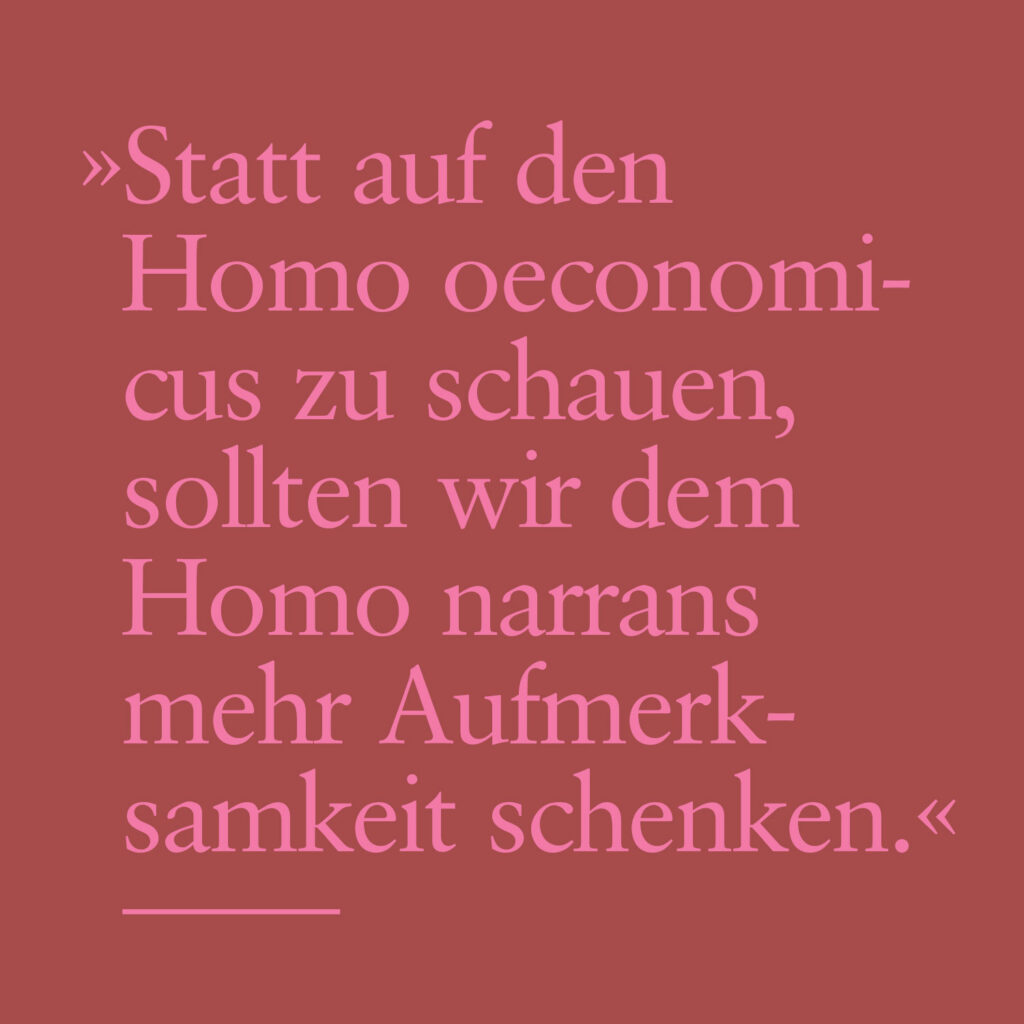
The hardest part of this is the struggle to arrive at a shared vision that can replace the multitude of pieces of information and interpretations. At first, no one is in charge; instead, everyone sits around a campfire and works together to shape what the future narrative will be. Openness to the grapevine—which can certainly become a driving force for innovation—helps counter uncertainty. It seems to me that we should pay more attention to Homo narrans than to Homo oeconomicus.
How do you deal with the different interpretations you encounter every day? In your day-to-day work, how do you figure out what the heart of the matter is and lay the groundwork for effective action? I look forward to hearing your thoughts on this.