Hello from Hamburg,
There is unrest in many companies. One reason for this is that existing organizational structures no longer align with the tasks at hand and are in need of an overhaul. In recent years, many companies have added new departments and hierarchical levels, resulting in increasingly complex structures that require ever-greater coordination. Confusing processes, roles, and responsibilities lead to paralyzing, endless discussions about who is in charge of what. The result of this growing dysfunction is laborious decision-making processes, increased silo and departmental thinking, duplication of work, and far too many ineffective meetings. It’s a state in which the organization is primarily preoccupied with itself. The customer is a nuisance.
Management thought leader Gary Hamel, who is advising the chemical and pharmaceutical giant Bayer on its current organizational restructuring, referred to this situation as “office sclerosis” in an interview with *Handelsblatt* published in October. As companies grow, more and more layers of management are added. Behind this lies an organizational model from the early days of industrialization: Managers respond to the desire to efficiently handle all of a company’s tasks with comprehensive control. This understanding of organization proves unsuitable in times of high uncertainty, rapidly changing markets, completely transformed communication patterns, and intelligent technology that can take on more and more work. The organizational chart—with its pyramid-shaped boxes, the boss at the top, and the absence of cross-functional project teams and customers—is emblematic of the old-order mindset of controlling work.
There’s so much friction in companies because we’re trying to tackle new challenges with old ways of thinking: “Which department does Sabine belong to now? (We’re splitting her up instead of working together!),” “Who oversees the regions?” “Where do we stick Michael (the poor guy)?” An organization adapted to the needs of our time, on the other hand, must ask itself: How do we balance tasks and processes so that we lack neither the necessary dynamism nor flexibility and freedom? How do we design our organization to be customer-focused and adaptable? How do we grant freedom of action while ensuring that we’re all moving in the same direction?
This rethinking isn’t limited to Bayer. For a good ten years now, new organizational models have been tried out everywhere. These include non-hierarchical models such as pure network organizations or holacracies. Or models that strike a balance between a hierarchy of responsibility and personal accountability, such as the Dynamogram, or the breaking down of an organization into individual companies, as seen with the Chinese home appliance manufacturer Haier. We recently came across one of the most intriguing examples in rural Hesse: A wood construction company has arranged its tasks and teams in a cycle—just as the customer experiences the company: sales, planning, manufacturing, installation, and handover to the customer. Support functions such as finance and controlling, innovation, strategy, and human resources are positioned in the center. Senior management does not appear in this structure.
The struggle over the organization’s future is further fueled by the fact that, according to a recent McKinsey study, at least 30 percent of every work hour could be intelligently automated by 2030. Soon, many processes and workflows will be replaced by generative artificial intelligence. Amazon, with its fully automated decision-making processes for onboarding as well as pricing and revenue generation, has long exemplified this trend, which has also led to the separation of suppliers on its platform. According to the Stanford Institute for Human-Centered Artificial Intelligence, the interaction between humans and machines within an organization could soon look like this: Artificial intelligence identifies decision-making leeway, models decisions, and measures their implementation. It evaluates, experiments, and optimizes based on analyses, and proposes goals and ways to measure them. It assembles teams from networks both within and outside the organization and recommends roles and structures for task completion. The human part of the organization determines the strategy, reviews it continuously, adapts it (“strategizes”), defines success, weighs options, resolves conflicting goals, and oversees the artificial intelligence.
Even without artificial intelligence, these upheavals undoubtedly place an unreasonable burden on everyone involved. A senior Bayer executive who oversees cross-functional tasks comments on the change process from her perspective: “I no longer know who to turn to when I have a technical question. With so many self-managed teams, I’ve lost track of everything. Who does what? Who should I turn to when I have a technical question?” It remains to be seen whether this observation reflects the natural growing pains of a temporary situation or whether the initiative is failing.
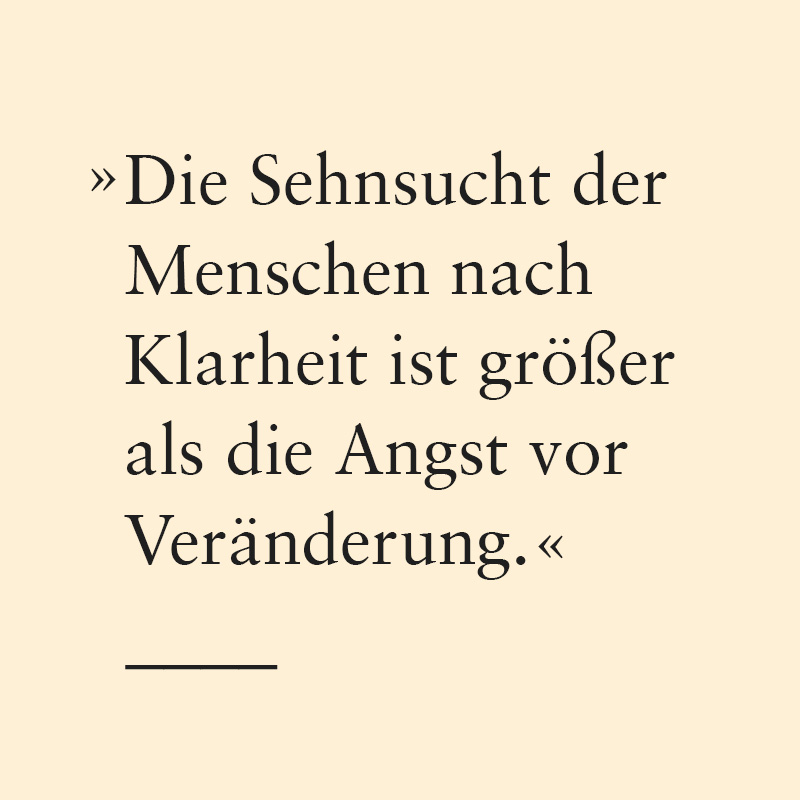
The good news: People’s longing for clarity seems to outweigh their fear of change. “Finally!” is the reaction to clear words, given the unmistakable feeling that things cannot go on this way. If used wisely, this longing could lay the foundation for the success of the upcoming changes.