Hello from Hamburg,
Recently, the managing partner of a medium-sized electrical engineering company in the Allgäu region told me that ten years ago he decided to run his company as a team. At the time, he asked himself why he thought he knew everything on his own and could make the best decisions. Since then, he has been solely a member of the management team and runs the company as part of a non-hierarchical team.
The list of arguments against a collective leadership model at the top is long: conflicts are inevitable. Decision-making processes are delayed by lengthy discussions. Grassroots democracy in corporate leadership leads to confusion and a lack of direction within the company. Collective responsibility means that no one feels responsible. In the worst-case scenario, this can lead to a stalemate that jeopardizes the company. Marvin Bower, the longtime CEO who once built the management consulting firm McKinsey into a powerhouse, puts it bluntly: “Power sharing never works.”
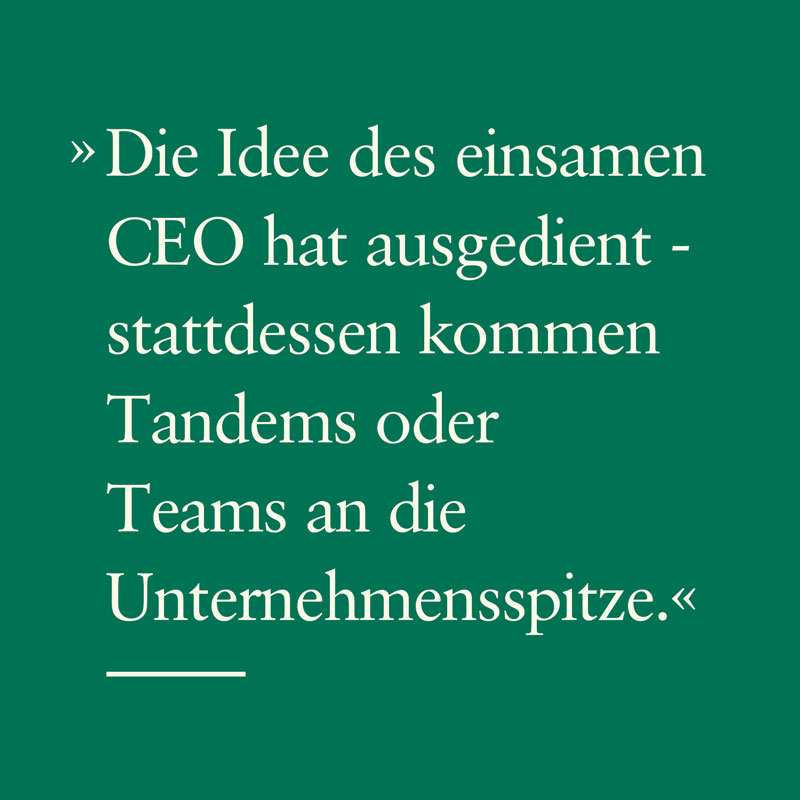
I am convinced that this is wrong. And that, given the convergence of crises and opportunities we are currently experiencing, the idea of the lone wolf at the helm has had its day. The sheer flood of issues we face alone requires teamwork, even in the leadership of a company. One person handles the technology needed to transform the company, while another focuses on increasing efficiency in the traditional core business, which will continue to finance the new business models for the time being. For a long time, when filling executive positions, the question was: Do we need a strategic thinker or an operational implementer? Today, we need not only both, but many different skills at once, as the strategy consulting firm Strategy& revealed in a 2021 survey of 515 managers from around the world. It found that the greatest shortfall lies in the absence of necessary paradoxes: the strategic implementer who is both integrative and assertive. The tech-savvy humanist. The humble heroine. The globally active, locally grounded leader. The innovator who upholds a company’s traditions. We must work in networks with changing partners while simultaneously holding the company together. We must make decisions amid great uncertainty: whether to invest here or there, to try this or that, and when to let go of what we’ve grown to love.
In her opening address—well worth listening to—at this year’s Global Leadership Summit of the CogX Festival in London, Rania, Queen of Jordan, said the following about the challenges of leadership in our time: “I used to think that the strongest leaders were the ones with the firmest convictions. Now I believe that inviting doubt is how we test the strength of our convictions. (…) The greatest risk we face today is indulging in unchecked certainty.” Embedding doubt in decision-making processes. Putting certainties and preconceptions to the test. How else can necessary paradoxes be lived out except among equals?
Serious long-term studies show that companies led by a team or co-CEOs create significantly more value than those led by a lone wolf at the helm. Not just on average—a few of them perform significantly better. According to this study, a key factor for success is that such structures help keep egos in check.
Of course, there need to be rules that a top-tier team or tandem internalizes and continually reaffirms: Everyone must want this kind of structure, be open-minded, be willing to listen, be ready to let the better argument prevail, enjoy the debate, and at the same time remain goal-oriented. There needs to be a clear, complementary division of responsibilities and tasks. Binding decision-making, conflict-resolution, and escalation mechanisms—the “consent” procedure derived from sociocracy could be just as helpful as the agreement to let the person with a noticeably stronger opinion and conviction on a given topic prevail. Equally important: speaking with one voice to the organization. Agree on an exit strategy that allows the team to part ways amicably. After all, as the entrepreneur from the Allgäu region mentioned at the beginning has experienced: Nothing lasts forever; a team and an organization are dynamic organisms that are constantly changing.
Anyone who is opposed to a peer-based leadership structure should ask themselves: Can my ego handle this? What does that say about me and my understanding of myself and leadership? Am I still the right person for these times?
As I write this newsletter, it occurs to me: In my business and philanthropic endeavors, I have always instinctively sought out—and found—a partner or team. Not only does this make things easier, but it’s simply much more fun.